
The management of equipment cleaning operations, and in particular sprayers, is a subject that is often overlooked, although in reality it is a fundamental function for two main reasons: first of all, maintaining work equipment in good condition allows it to be maintained as well as possible over time and in the best conditions.
Secondly, coupled with this practice, there is the problem of environmental pollution: this is the contamination by plant protection products used on a limited surface of land, which is systematically repeated over time.
SUCCESSFUL EQUIPMENT MAINTENANCE AND PROTECTION FROM ENVIRONMENTAL POLLUTION
The operations that can increase the risk of this contamination are during the filling and cleaning phase of the sprayer, as well as the management of waste/residues from the treatment itself. As already mentioned, it is strongly recommended to thoroughly clean the sprayers each time the treatment is completed/interrupted, in order to maintain the individual components, such as pipes, regulation systems, valves, nozzles, internal and external walls of the tanks, etc., in the best possible condition.
Therefore, proper maintenance of work equipment is a rule that falls within good agricultural practice. Moreover, in the case where the treatment with a specific type of plant protection product has been completed and the subsequent use of the equipment using another type of product is planned (e.g. first a herbicide and then a fungicide, etc.), it is very important to ensure adequate internal cleaning of the sprayer, so that no phenomena of physico-chemical incompatibility between them appear.
Similarly, the use of the sprayer in a crop different from the one that has already been carried out, e.g. the use of a selective herbicide for a specific crop does not necessarily mean that it will also be selective for another and if carried out without adequate cleaning of the equipment, it can cause dangerous phytotoxicity phenomena.
Finally, if the solution and the active ingredients in the sprayer are not sufficiently removed at the end of each application, clogging of the nozzles is caused due to the accumulation and drying of the solution used.
It is highly recommended to clean the sprayer in those areas of the land where there is no risk of surface and/or groundwater contamination, always taking into account that the sprayer cleaning process must never cause the maximum dose of the plant protection product permitted on the label to be exceeded. When it is not possible to rinse the equipment directly in the field, it is necessary to organize a specially equipped area for the correct execution of the cleaning. In order to avoid as much as possible localized pollution phenomena, it is necessary that the area where the equipment is washed is paved and possibly equipped with a system for collecting water contaminated with chemical products in a special tank, so that it can be disposed of in accordance with good agricultural practices and in accordance with current legislation.
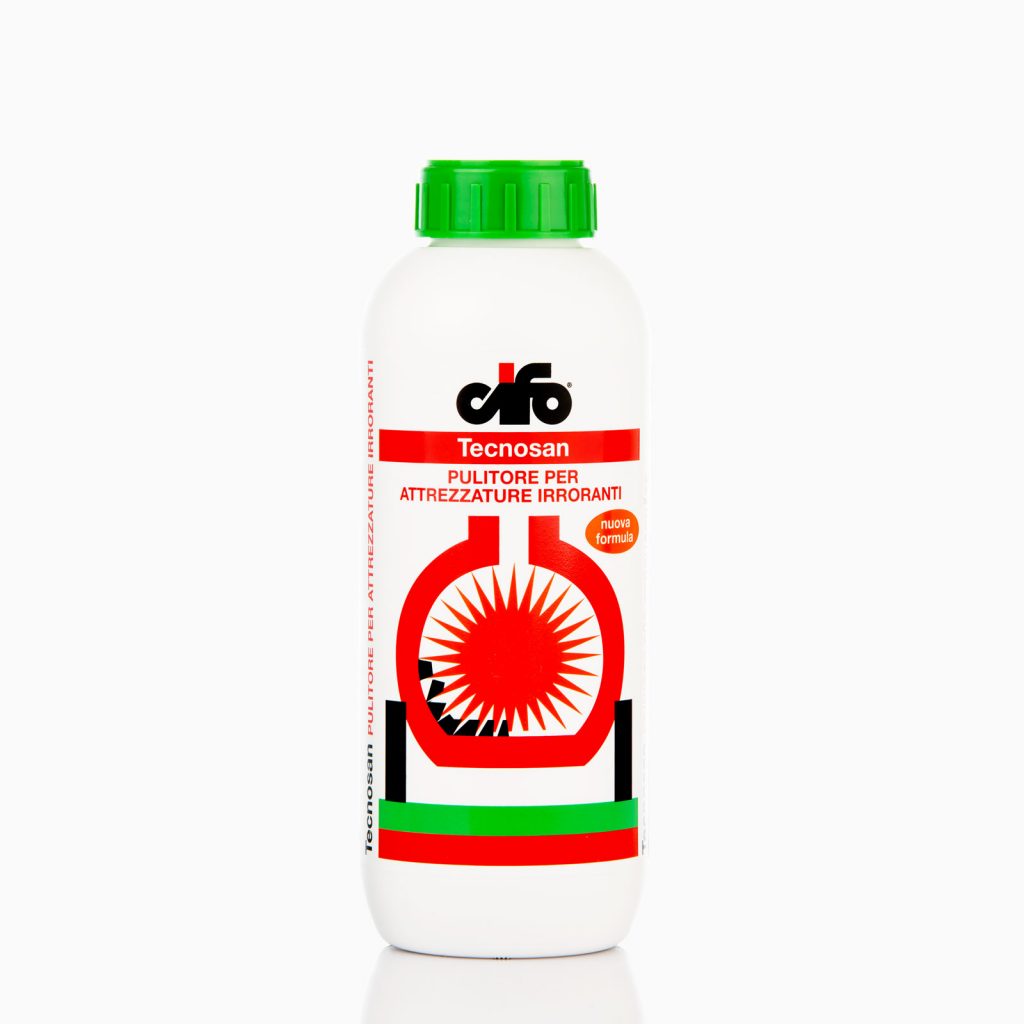
THE SOLUTION FROM CIFO: TECNOSAN
Cifo, always on the side of farmers, offers a solution in this case: the Tecnosan product has been specially designed for use during washing and cleaning operations of the equipment used and is especially recommended for those machines whose cleaning is particularly difficult.
In particular, the Tecnosan formulation is able to carry out two activities that are both different and complementary against dirt. The product acts first by oxidizing organic molecules and then performs its cleaning action on the surfaces of the equipment. A simple rinse after washing is enough to eliminate all traces of the solution, thus allowing the equipment to be thoroughly cleaned and free from unwanted substances.
METHOD OF APPLICATION
Put approximately 50 liters of water in the tank. It is recommended to use water that is not too cold. Add 200 mL of Tecnosan .
At this point, start the agitator so that the solution circulates through the pipes and the pump, until the inner walls of the tank are completely washed.
The water will turn red-violet if residues are found and will gradually turn brown. The change in color is due to the specific action of the product that has exhausted its cleaning function. Operate the sprayer to also clean the nozzles.
Then, rinse all the equipment thoroughly with clean water.
ADVANTAGES OF USING TECNOSAN
- Less water waste
- Less time for cleaning work
- Safety of treatment after washing